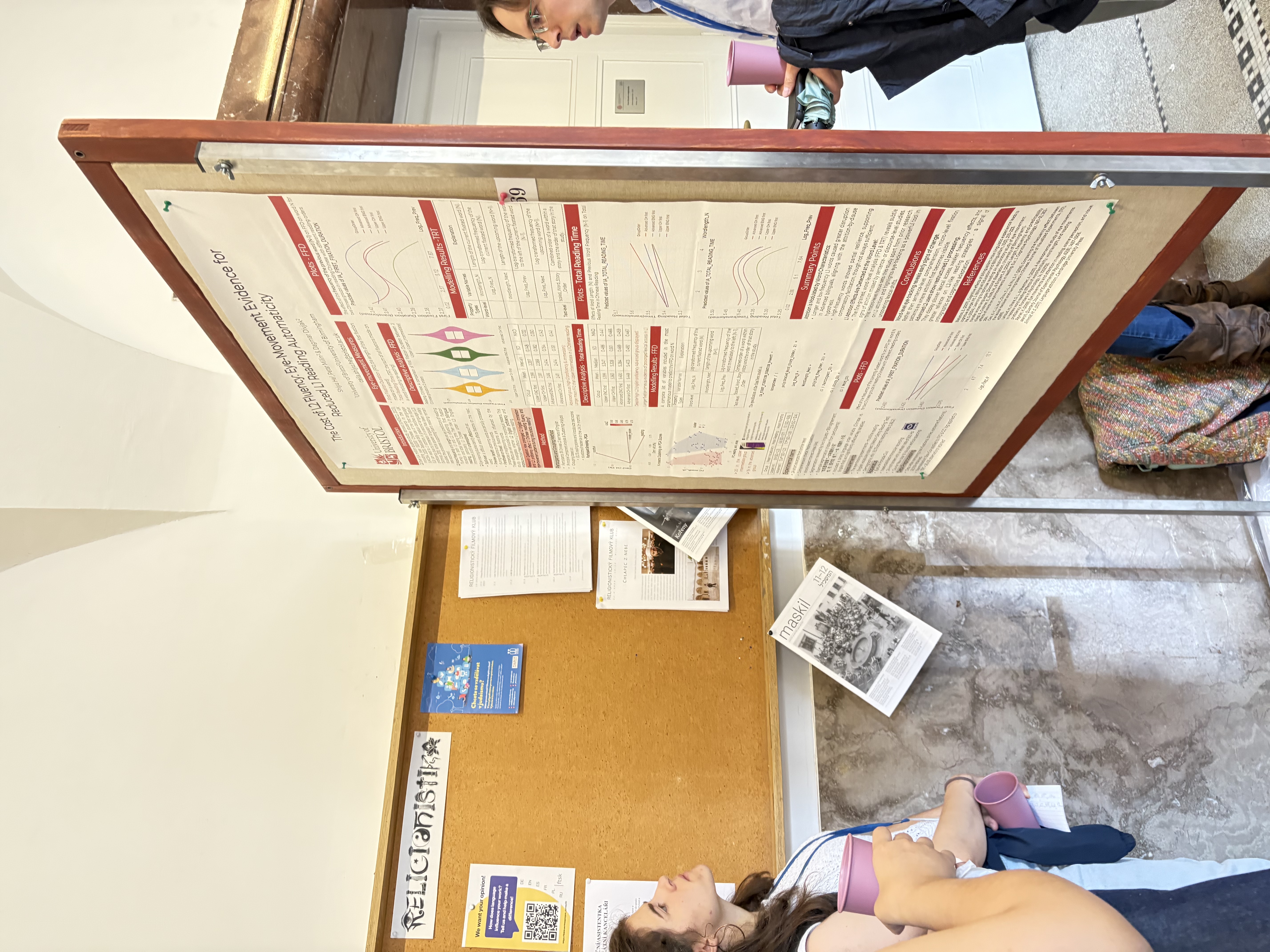
The Cost of L2 Fluency: Eye-Movement Evidence for Reduced L1 Reading Automaticity
Date:
Abstract
Word frequency and length are well-established predictors of reading fluency in both L1 and L2, influencing eye-movement measures such as first fixation duration and total reading time. However, the influence of these factors on reading fluency in bilinguals remains underexplored. This study investigates whether L2 English proficiency and exposure modulate the effects of word frequency and length on L1 Chinese reading.
Forty native Chinese speakers with university-level education were classified into Advanced and Upper Intermediate groups based on Principal Component Analysis and non-hierarchical Cluster Analysis of English vocabulary size, IELTS scores, and years of residence in the UK. Participants read 24 short Chinese texts while their eye movements were recorded.
Linear mixed-effects models examined first fixation duration and total reading time at word N, as well as spill-over (N−1) and parafoveal preview (N+1) effects. Advanced L2 English readers showed significantly longer fixation durations than the Upper Intermediate group, particularly for low-frequency and longer words. These effects were strongest at the fixated word and weaker in adjacent regions.
The findings suggest that increased L2 proficiency and exposure may reduce L1 reading automaticity, consistent with early stages of L1 attrition. By demonstrating how L2 experience reshapes sensitivity to lexical properties in L1 reading, this study contributes to models of bilingual language processing and highlights the potential cost of advanced L2 fluency for native-language reading.
Gallery